
New Construction Radon Systems and Passive Stack Activation
Call (605) 210-7667 You hear back from a person, not an autoresponder, within one business day. Call before 3pm on a weekday and it is usually the same afternoon.
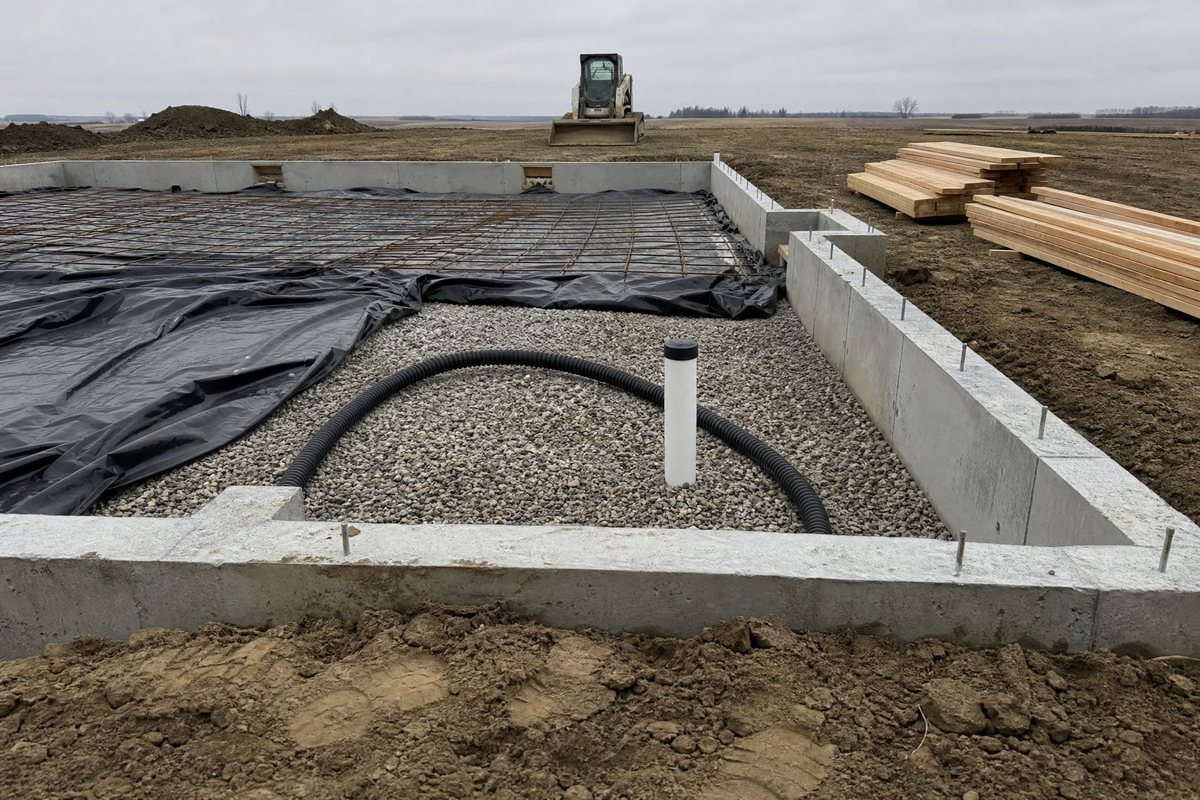
Two different customers here, so this page covers both. Builders roughing in before a pour, and homeowners who moved into a newer house and eventually noticed a white pipe that appears to do nothing.
If you have a passive stack, this is the cheapest job we do
Homes built around Sioux Falls in roughly the last fifteen years often came with passive radon piping: a perforated line in the sub-slab gravel, a stack running up through the house, and a cap on the roof. No fan. The theory is that warm air rising in the pipe creates enough draft to move soil gas. In South Dakota, with our soil and our levels, it usually does not get a house under 4.0 on its own. Adding a fan, a manometer and a labeled electrical connection to an existing stack is a fraction of a full install because the expensive part, the pipe, is already in the walls. Test first, then activate if the number says so.
Builders: doing this before the pour costs almost nothing
Minnesota has required radon-resistant construction in new homes since 2009. South Dakota does not require it, which is somewhat remarkable given that this state has the highest average indoor radon level in the country. For a builder, a rough-in during construction runs a small fraction of what retrofitting the same house costs after drywall, and it is a straightforward selling point in the Harrisburg and Tea growth corridor where buyers are increasingly asking. Four inches of clean aggregate, a perforated loop, sealed sheeting, a capped riser to the attic, and a labeled junction box for a future fan. Half a day of work on a house that will stand for eighty years.
One caution on new builds
A rough-in is not a mitigated house. Passive piping means the house is ready, and the only thing that tells you whether it needs a fan is a test after occupancy, once the HVAC is balanced and the house is being lived in. Test at the one-year mark. Builders who market a passive stack as though the radon question is settled are creating a callback for somebody.
How much does it cost to activate a passive radon system?
Typically a few hundred dollars in the Sioux Falls area, since the pipe already exists. The work is a fan, a manometer, an electrical connection and a post-activation test.
Does South Dakota require radon-resistant new construction?
No. South Dakota has no requirement for radon-resistant construction and no requirement to test, only a seller disclosure law for known levels. Minnesota has required radon-resistant new construction since 2009.
Where does the fan go on a passive system?
Never in the conditioned space below the living area. Code and good practice put it in an attic, a garage attic, or outside, so that any leak in the positive-pressure side of the fan discharges outside the house rather than into it.
Available across the Sioux Falls area
- New Construction & Passive Systems in Brandon
- new construction & passive systems for Harrisburg homes
- New Construction & Passive Systems in Tea, SD
- New Construction & Passive Systems in Hartford, SD
- New Construction & Passive Systems in Crooks, SD
- New Construction & Passive Systems in Dell Rapids, SD
- Brookings New Construction & Passive Systems
- New Construction & Passive Systems in Watertown
Also serving Baltic, Lennox, Canton, Vermillion, Madison, Yankton, Mitchell for this service. Call and ask when we are next in your direction.
Related radon services
Need new construction and passive system activation in Sioux Falls? Call (605) 210-7667 or send the form for a written, itemized quote. Back to radon mitigation in Sioux Falls.